
15 Top SOAR Security Vendors List 2026
The 15 SOAR platforms worth evaluating in 2026, compared on playbook style, case management, deployment and fit.
Quick answer
The leading SOAR (security orchestration, automation and response) vendors in 2026 fall into four overlapping groups. Established enterprise SOAR: Palo Alto Cortex XSOAR, Splunk SOAR, Swimlane Turbine and FortiSOAR. Modern security automation / agentic platforms: Torq, Tines, D3 Smart SOAR and Cyware Orchestrate. Ecosystem-integrated / cloud security automation: Microsoft Sentinel, Google Security Operations SOAR, Rapid7 InsightConnect and Sumo Logic Cloud SOAR. Existing-estate SOAR platforms: IBM QRadar SOAR, OpenText ArcSight SOAR and NetWitness SOAR. These are overlapping ZCybersecurity editorial groupings to aid comparison, not an official industry taxonomy, several vendors could sit in more than one, and the right choice depends on your SIEM/XDR, deployment model and how much automation you want to run.
On this page
| Vendor: Product | Best for | Deployment | Playbook style | Case management |
|---|---|---|---|---|
| Established enterprise SOAR | ||||
| 1. Palo Alto: Cortex XSOAR | Large enterprise SOCs | Cloud / hybrid | Low-code / code | Native (full) |
| 2. Cisco/Splunk: Splunk SOAR | Splunk shops | Cloud / on-prem | Visual / code | Native (full) |
| 3. Swimlane: Turbine | Regulated industries | Cloud / self-hosted | Low-code | Native (evidence & approvals) |
| 4. Fortinet: FortiSOAR | Fortinet / MSSP / OT | On-prem / cloud | No-code / low-code | Native (full) |
| Modern security automation / agentic | ||||
| 5. Torq: HyperSOC | Autonomous Tier-1 triage | Cloud (SaaS) | Agentic / natural-language | Native |
| 6. Tines | Cross-functional automation | Cloud / self-hosted | No-code workflows | Light / external |
| 7. D3 Security: Smart SOAR | Broad codeless integrations | Cloud / on-prem | Codeless (+ agentic) | Native (full) |
| 8. Cyware: Orchestrate | Threat-intel-driven SOCs | Cloud / on-prem / hybrid | Low-code / agentic | Decoupled (optional) |
| Ecosystem-integrated / cloud security automation | ||||
| 9. Microsoft: Sentinel | Microsoft-centric SOCs | Cloud (Defender portal) | Logic Apps / AI-generated | Native (Defender incident) |
| 10. Google: Security Operations SOAR | Google SecOps users | Cloud (SaaS) | Low-code / AI-assisted | Native (full) |
| 11. Rapid7: InsightConnect | Mid-market, Rapid7 users | Cloud-native | No-code | SIEM-paired (InsightIDR) |
| 12. Sumo Logic: Cloud SOAR | Cloud-first SOCs | Cloud (SaaS) | Low-code | Native (full) |
| Existing-estate SOAR platforms | ||||
| 13. IBM: QRadar SOAR (on-prem) | Existing IBM/QRadar estates | On-premises | Low-code / script | Native (full) |
| 14. OpenText: ArcSight SOAR | Existing ArcSight estates | On-prem | Low-code | Native / SIEM-paired |
| 15. NetWitness: Orchestrator | Existing NetWitness estates | On-prem / cloud | Low-code | Native (war room) |
Evaluating your options?
Tell us what you're looking for and we can help identify relevant providers or specialists.
Get matched with a providerHow we selected these vendors
We started from the platforms security teams actually shortlist in 2026, then reverified each against current first-party product documentation and release notes, confirming the product still exists, its current name, deployment model and core capabilities. We removed dated or discontinued entries (old names like Demisto, Siemplify and DFLabs IncMan now map to current products) and excluded tools that are really SIEMs rather than SOAR. For easier comparison we group the 15 platforms by the buying situations in which they are most likely to be evaluated. These are overlapping ZCybersecurity editorial groupings, not an official industry taxonomy, several vendors could reasonably sit in more than one group.
SOAR vendor reviews
Established enterprise SOAR
1. Palo Alto Networks: Cortex XSOAR
An established enterprise SOAR platform with one of the largest integration marketplaces, low-code and code playbooks, full native case management and built-in threat-intelligence management. It is the archetypal deterministic, DAG-style SOAR and sits alongside Palo Alto’s Cortex XSIAM. Best for large SOCs that want maximum breadth. Consider: pricing is quote-based, so validate licensing, implementation and ongoing operating costs against your needs.
2. Cisco / Splunk: Splunk SOAR
Visual and code-based playbook automation that integrates into the Splunk Enterprise Security analyst workflow, within Cisco’s portfolio following the Splunk acquisition. Best for organizations standardized on Splunk. Consider: its value depends on Splunk being your SIEM.
3. Swimlane: Turbine
Low-code automation with case management that includes evidence tracking, chain of custody and approval workflows, which suits teams where SOAR doubles as a compliance record. Best for regulated industries such as financial services, government and healthcare. Consider: assess how its governance and case-management model fits your workflow-authoring and approval process.
4. Fortinet: FortiSOAR
No-code/low-code playbooks, built-in threat intelligence, multi-tenant architecture for MSSPs and OT-security automation, integrated with FortiGuard. Best for Fortinet-ecosystem shops, MSSPs and OT environments. Consider: deepest value inside the Fortinet Security Fabric.
Modern security automation / agentic platforms
5. Torq: HyperSOC
A security automation platform positioned around agentic and hyperautomation workflows, with a natural-language interface aimed at automating Tier-1 triage rather than only accelerating it. Best for teams that want to offload Tier-1 triage to autonomous workflows. Consider: evaluate case management, reporting, auditability and autonomy controls against your SOC requirements.
6. Tines
A no-code automation platform prized for how quickly teams ship workflows, used across security and broader IT and operations, a cross-functional automation layer as much as a SOAR, with a free Community tier. Best for engineer-friendly, mid-market teams. Consider: lighter native case management; often paired with a separate system of record.
7. D3 Security: Smart SOAR
Codeless playbooks plus an Event Pipeline and full native case management. D3 positions its Event Pipeline as a way to normalize, deduplicate and reduce event noise before incidents are created, and also markets an agentic layer (Morpheus). Best for teams wanting broad, vendor-maintained integrations without heavy scripting. Consider: validate the agentic capabilities against your requirements.
8. Cyware: Orchestrate
Low-code, vendor-agnostic orchestration that deliberately decouples automation from incident response and case management, with agentic-AI playbook building and a broad integration marketplace. Best for threat-intel-driven SOCs and collaborative/ISAC use cases. Consider: case management is handled as a separate concern.
Ecosystem-integrated / cloud security automation
9. Microsoft: Sentinel
Sentinel is primarily Microsoft’s cloud SIEM/SecOps platform, but it includes substantial SOAR through automation rules, Logic-Apps-based playbooks and Microsoft’s newer AI playbook generator (generally available in 2026) in the Defender portal. On cost: eligible Microsoft 365 E5-family customers may receive a Sentinel data-ingestion benefit for qualifying Microsoft 365 data, this is not the same as Sentinel being fully free, and Logic Apps consumption charges apply to high-volume automation. Best for Microsoft-centric SOCs.
10. Google Cloud: Security Operations SOAR
The standalone SOAR within Google Security Operations (formerly Siemplify, then Chronicle SOAR), with a broad integration library, a threat-centric case model and AI-assisted playbook creation. Best for teams consolidating on Google SecOps. Consider: it is strongest inside that ecosystem.
11. Rapid7: InsightConnect
A cloud-native SOAR with an extensive plugin library and native integration with Rapid7’s InsightIDR (SIEM) and InsightVM. Best for mid-market teams, especially existing Rapid7 customers. Consider: its investigation/case layer leans on InsightIDR.
12. Sumo Logic: Cloud SOAR
A cloud-native SOAR (formerly DFLabs IncMan) automating triage, investigation and remediation through an open integrations framework, ML-assisted correlation and an Automation Bridge that runs playbook actions inside your environment; actively updated in 2026. Best for cloud-first SOCs and Sumo Logic customers. Consider: tightest fit as a Sumo Logic add-on.
Existing-estate SOAR platforms
13. IBM: QRadar SOAR (on-premises)
IBM’s on-premises QRadar SOAR (formerly Resilient) is actively released in 2026 and is known for codifying incident response into dynamic playbooks with breach and privacy-reporting workflows. Note the distinction: IBM’s QRadar SaaS assets were divested to Palo Alto Networks in 2024 and that SaaS line is being retired. New buyers should verify IBM’s current roadmap and long-term support strategy before selecting the on-premises product for a greenfield deployment. Best for existing IBM/QRadar estates.
14. OpenText: ArcSight SOAR
Part of OpenText’s ArcSight line; playbook-based orchestration that pairs with ArcSight ESM’s correlation engine and native SOAR. Best for organizations with existing ArcSight estates, where it is primarily deployed. Consider: in our view it fits best as a continuity choice for an existing estate rather than a new standalone SOAR.
15. NetWitness: Orchestrator
Now presented as NetWitness SOAR: playbook automation, a broad integration set and a chat-ops “war room,” part of the converged NetWitness platform spanning NDR, SIEM, UEBA and SOAR. Best for teams already on the NetWitness platform. Consider: value is realized inside the NetWitness suite.
Adjacent option: LogRhythm SmartResponse (LogRhythm is now part of Exabeam) provides SIEM-embedded response automation for its customers, but it is not a standalone SOAR in the same class as the platforms above.
Is SOAR still relevant in 2026?
Yes. Alert volumes keep rising and skilled analysts remain scarce, so the need to automate enrichment, response and case handling has not gone away. What is changing is how that automation is built: SIEM vendors now bundle native automation, and a wave of AI/agentic tools can reason through triage rather than follow fixed playbooks. The orchestration-and-response layer is evolving, not disappearing.
SOAR vs SIEM vs XDR
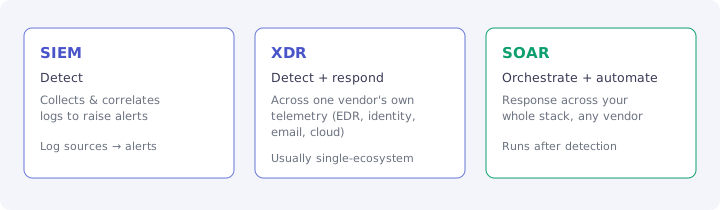
These three overlap but do different jobs. A SIEM collects and correlates logs to detect. XDR detects and responds across a vendor’s own telemetry, endpoint, identity, email, cloud, usually within one ecosystem. SOAR orchestrates and automates response across your whole stack, regardless of vendor. XDR can reduce how much cross-tool orchestration you need, but rarely removes it: most organizations still run SOAR alongside a SIEM to automate response across tools that do not natively talk to each other.
How AI is changing SOAR in 2026
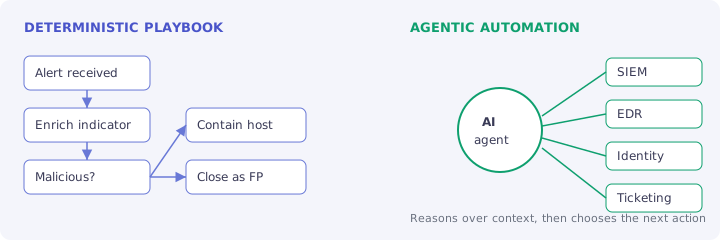
SOAR selection is no longer only a comparison of connector counts and playbook builders. Buyers now also have to decide how much AI-assisted or agentic decision-making they are willing to introduce into investigation and response, a major new evaluation dimension this year. In practice that shows up as AI playbook generation (Microsoft Sentinel builds playbooks from natural language), agentic triage that acts with less human authoring (Torq, D3 Morpheus, Cyware), and natural-language interfaces over existing automation. The trade-off is control: the more autonomy you grant, the more your evaluation should weigh transparency, guardrails and auditability alongside speed.
How to evaluate SOAR vendors
Fit matters more than feature counts. Weigh these against your environment:
- Deterministic vs. agentic automation: how much AI-driven decision-making you want in investigation and response, one of the most important architecture decisions in 2026, though rarely a binary choice.
- Integration breadth & quality: how many of your tools have vendor-maintained connectors, and how easily you build the rest.
- Case-management depth: a full native investigation workspace versus lighter automation that leans on your SIEM.
- Deployment & data residency: cloud-native, on-prem or hybrid, matched to your constraints.
- SIEM/XDR ecosystem: standalone platform versus automation bundled into a SIEM you already run.
- Commercial model: quote-based licensing, published entry pricing or free/bundled tiers, and consumption costs.
- MSSP & multi-tenancy: essential if you manage multiple client environments.
SOAR for MSSPs: what to evaluate
Managed providers have needs a single-tenant buyer does not. Prioritize genuine multi-tenancy with strict per-client data isolation, the ability to build a playbook once and deploy it across many tenants, per-client reporting and SLAs, and role separation for client-facing analysts. FortiSOAR, Cyware Orchestrate and D3 are among those that market multi-tenant architectures, validate the isolation model against your own client mix before committing.
How to start with SOAR: test three workflows first
Do not try to automate everything at once. Prove value on three high-frequency, low-regret workflows before expanding:
- Phishing triage. Auto-extract indicators from reported emails, enrich against threat intel, and pre-classify, the highest-volume queue in most SOCs.
- Suspicious identity/login enrichment. On a risky sign-in, gather user, device, location and prior-activity context automatically so an analyst decides with the full picture in seconds.
- Endpoint containment with human approval. Prepare the isolate-host action and route it for one-click analyst approval, automation with a human in the loop, which builds trust before fully autonomous response.
What is SOAR security?
SOAR stands for Security Orchestration, Automation and Response, platforms that connect your security and IT tools, automate repetitive analyst tasks, and coordinate incident response through playbooks. Orchestration connects disparate tools so they act as one system; automation executes routine tasks without manual steps; response ties it together with playbooks and case management that guide and document how incidents are handled.
The three core capabilities of a SOAR platform
Whatever the brand, a capable SOAR platform delivers broad, reliable integrations so it can read alerts and act across your stack; flexible playbook automation, increasingly agentic, that a team can maintain without engineering every workflow; and strong case management that centralizes investigation, collaboration and an auditable record of every action.
SOAR and incident response
SOAR operationalizes your incident-response plan: instead of analysts working a runbook step by step, playbooks execute the predictable parts, gathering evidence, enriching indicators, isolating a host, notifying stakeholders, while the case wall documents everything. See our guides to SOAR playbook examples and SOAR use cases.
SOAR vendors FAQ
Does SOAR require coding?
Not necessarily. Most 2026 platforms offer no-code or low-code playbook builders, and several generate playbooks from natural language. Code is optional for advanced custom actions rather than a baseline requirement.
How long does SOAR implementation take?
It varies with scope. Teams typically see value fastest by starting with one or two high-volume workflows rather than a full rollout up front.
Which workflows should a SOC automate first?
Phishing triage, suspicious identity/login enrichment, and endpoint containment with human approval are common starting points, high-frequency, high-value and low-risk when a human stays in the loop.
Can SOAR isolate endpoints automatically?
Yes, through EDR integrations, but most teams gate containment behind analyst approval at first and move to fully automated isolation only once the playbook has proven reliable.
How should organizations measure SOAR value?
Common measures are mean-time-to-respond, the share of alerts handled automatically, analyst hours saved, and consistency of response.
What should MSSPs test when selecting SOAR?
Multi-tenant isolation, deploy-once/run-across-tenants playbook management, per-client reporting and SLAs, and role separation for client-facing analysts.
Sources
- Palo Alto Networks: Cortex XSOAR product page
- Splunk (Cisco): Splunk SOAR product page
- Swimlane: Turbine
- Fortinet: FortiSOAR product page
- Torq: HyperSOC
- Tines: platform & Community edition
- D3 Security: Smart SOAR
- Cyware: Orchestrate
- Microsoft Learn: Automation in Microsoft Sentinel
- Google Cloud: Google Security Operations (SOAR)
- Rapid7: InsightConnect product page
- Sumo Logic: Cloud SOAR documentation
- IBM: QRadar SOAR 2026 release announcement
- OpenText: ArcSight SOAR (OpenText Cybersecurity Marketplace)
- NetWitness: SOAR module
Updated for 2026
- Product list reverified against first-party sources.
- Demisto → Palo Alto Cortex XSOAR; Siemplify → Google Security Operations SOAR; DFLabs IncMan lineage → Sumo Logic Cloud SOAR.
- Duplicate Swimlane entry removed; Exabeam Fusion (a SIEM) removed.
- Added Microsoft Sentinel automation, Tines, Torq, Cyware Orchestrate, NetWitness, D3 Smart SOAR.
- Added the deterministic-vs-agentic dimension reflecting 2026 market changes.
About the author

Related reading
Ready to shortlist providers?
Tell us what you're evaluating and we can help identify relevant providers or specialists for your environment.
Get matched with a providerAre you a vendor or service provider?
If your company is featured in this guide, you can submit factual product updates or request an editorial briefing. Editorial placement and ranking are independent of any commercial relationship. payment never affects position in this list.